FB Informatik, LS2, Univ. of Dortmund,
D-44221 Dortmund, Germany
Email: wegener@ls2.cs.uni-dortmund.de
A nondeterministic machine has the possibility to choose in each configuration its successor configuration from a finite set of configurations. It accepts an input iff there is a legal computation path to an accepting configuration.
The typical question of a student is: "How can we build such a machine?" The typical answer is that a nondeterministic machine cannot be built and that nondeterministic machines are abstract devices. One may have the idea of a machine which "guesses" the "right" successor configuration if there is one. Another idea is to think of a parallel computer where the different computation paths are followed by different processors. However, in order to simulate a nondeterministic machine for a linear number of steps we may need exponentially many processors. In any case, nondeterminism turns out to be "not realizable." I have held much more than thousand oral examinations on this subject and it has turned out that only excellent students do not have difficulties with the concept of nondeterminism.
Also the other well-known descriptions of nondeterminism are not useful in the very beginning. There is a logic-oriented description (using one existential quantifier for a string of polynomial length and a predicate which is decidable in polynomial time, see, e.g., Garey and Johnson (1979)) and a proof-oriented description (there is a proof of polynomial length convincing a polynomial-time verifier iff the input has to be accepted, see, e.g., Mayr, Prömel, and Steger (1998)). All in all, the common approaches to teach nondeterminism have serious drawbacks. Nevertheless, these descriptions of nondeterminism are useful and have to be taught later, but, as we think, not as first approach to nondeterminism.
Here we propose another approach to nondeterminism. It is not claimed that this approach is totally new. It has been mentioned at least implicitly at various places, but it has never been proposed as the first definition of nondeterminism students should see. The approach is to introduce randomized algorithms and then nondeterminism as a special kind of randomization. This approach has not been proposed in the sixties, seventies, or eighties of the last century, since then randomization was not such a fundamental concept in computer science as today. Nowadays, the design of data structures, algorithms, and search heuristics typically leads to solutions based on randomization (see any monograph on new algorithmic concepts). Hence, it is necessary to teach randomization in the basic courses on theoretical computer science.
In Section 2, we briefly discuss why randomization can and should be
introduced in basic computer science courses at universities. In Section
3, we describe complexity classes based on randomized computations and
introduce the landscape of these complexity classes. In Section 4, we show
how this approach leads directly to the concept of nondeterminism as a
special case of randomization. We finish with some conclusions and an outlook.
Randomization is the key to efficient and reasonable behavior in many situations. One famous example is game theory. Consider, e.g., the well-known game called scissors-paper-stone. If we are afraid that our opponent is psychologically superior, our only chance not to lose the game (in the long run) is the use of randomized strategies.
Cryptography and, therefore, data protection and the design of digital signatures are not possible without randomization. Keys have to be chosen randomly in order to confuse opponents. The most popular public-key cryptosystems work with very large prime numbers (approximately 500-1000 bits). How can one obtain such random prime numbers? One chooses random numbers and tests whether they are prime. Efficient deterministic primality test algorithms are not known and one uses randomized algorithms. With very small probability, such a test claims that a composite number is prime (false positive). The idea behind this test is the following. Each number smaller than the given number n is a possible witness that n is not prime. More precisely, if n is prime, there is no witness proving that n is not prime. However, if n is composite, at least half of all possible witnesses prove that n is composite (without revealing a proper factor of n). Using results from classical number theory it can be tested efficiently whether m is a witness to prove that n is composite (for details see Motwani and Raghavan (1995)). Some possible witnesses, perhaps 100, are drawn randomly. Either we have found a witness proving that n is composite or we believe that n is prime. If n is composite, the probability, that among 100 random possible witnesses there is no witness is bounded above by 2-100.
Primality testing is such a famous example, since the problem is important, no efficient deterministic algorithm is known, and the randomized algorithm is efficient and has a failure probability which can be accepted in applications.
"There are two principal advantages to randomized algorithms. The first
is performance - for many problems, randomized algorithms run faster than
the best known deterministic algorithms. Second, many randomized algorithms
are simpler to describe and implement than deterministic algorithms of
comparable performance" (Motwani and Raghavan (1995)).
This is the case when considering randomized skip lists instead of deterministic
balanced search trees, the fingerprinting techniques, game tree evaluation,
or randomized search heuristics like simulated annealing or evolutionary
algorithms. Already this short list of examples proves that students should
learn about randomization very early. Complexity theory has the task to
describe complexity classes related to randomized algorithms.
Which failure probabilities and refusal probabilities (the algorithm stops without result) do we accept? Let q(n) be an upper bound on the failure or refusal probability for inputs of bit length n:
The situation for two-sided error is more difficult. Some runs may produce the answer "yes" while other runs produce the answer "no." Since we only consider the case q(n)<1/2, the answers have a tendency to be correct. Therefore, we take a majority vote, i.e., we answer "yes" if a majority of the runs answer "yes" (ties can be broken arbitrarily). Using Chernoff bounds (see, e.g., Motwani and Raghavan (1995)) it can be proved that polynomially many runs and a majority vote decrease the failure probability from 1/2-1/p(n) for a polynomial p(n) to 2-n. This leads to the complexity class BPP (i.e. bounded-error probabilistic polynomial time), where q(n)<=1/2-1/p(n) or equivalently q(n)<=2-n, and the abstract complexity class BPP*, where q(n)<1/2.
Our considerations lead to the following landscape of complexity classes.
A directed edge from A to B corresponds to the relation A B.
B.
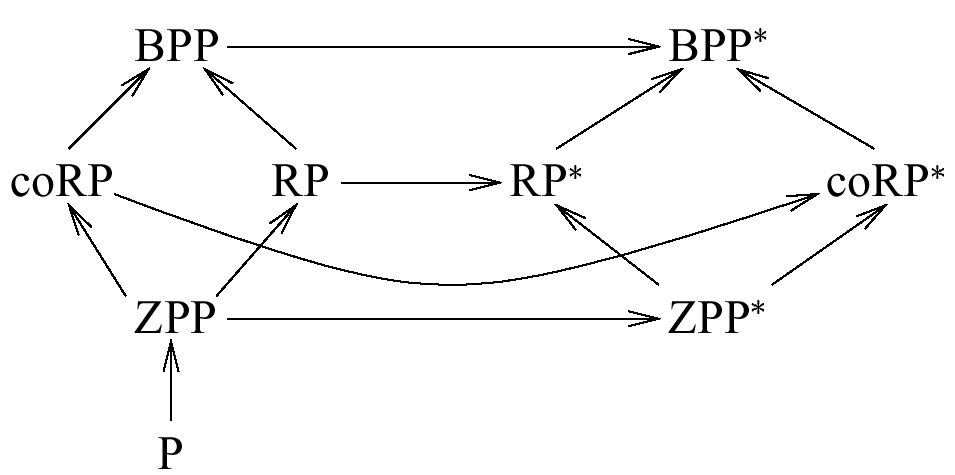 |
All relations in Figure 1 follow from our considerations, only the relation
RP*BPP*
needs a short proof. The complexity classes on the left side of Figure
1 contain problems which can be solved efficiently, while the complexity
classes on the right side seem to be of no practical use. With respect
to search problems we obtain a corresponding landscape without RP, coRP,
RP*, and coRP*, since one-sided error makes no sense for search problems.
One may argue that this is a long way, before we can introduce nondeterminism.
However, we argue that randomized algorithms are of such an importance
that students need to know about the different types of randomized algorithms
anyway and that, therefore, the landscape of complexity classes based on
randomized computations should be taught at the beginning of theoretical
computer science.
 BPP*.
We look for problems not known to belong to P which are contained in some
of the other complexity classes. Primality testing is contained in coRP,
since we only accept false positives and the failure probability of a single
test is bounded above by 1/2.
BPP*.
We look for problems not known to belong to P which are contained in some
of the other complexity classes. Primality testing is contained in coRP,
since we only accept false positives and the failure probability of a single
test is bounded above by 1/2.
Let us consider some decision problems and the decision variants of some well-known difficult optimization problems:
Indeed, RP* is the complexity class NP!
We reformulate the conditions for RP* algorithms:
We discuss one further simple result. If we have for some problem an RP-algorithm A and a coRP-algorithm A', we can run them independently and obtain a ZPP-algorithm A* in the following way:
 coRP
and, with the same argument, ZPP*=NPcoNP.
Indeed, the notations BPP*, RP*, coRP*, and ZPP* are not used and should
be replaced with PP, NP, coNP, and NPcoNP,
respectively (PP means probabilistic
polynomial time). Figure
2 shows the landscape of Figure 1 with the usual notation.
coRP
and, with the same argument, ZPP*=NPcoNP.
Indeed, the notations BPP*, RP*, coRP*, and ZPP* are not used and should
be replaced with PP, NP, coNP, and NPcoNP,
respectively (PP means probabilistic
polynomial time). Figure
2 shows the landscape of Figure 1 with the usual notation.
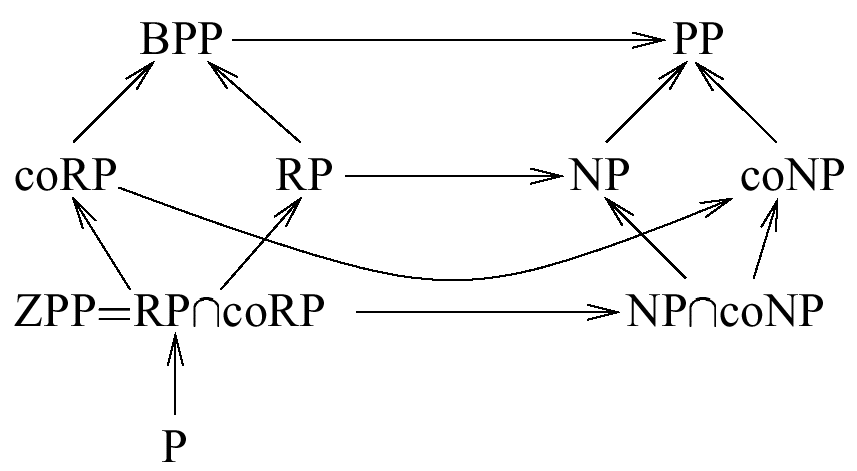 |
Hence, NP and PP belong to the set of complexity classes for randomized
computations with an unacceptable failure probability. PP is always considered
as a complexity class for randomized computations while NP is usually considered
as a complexity class for nondeterministic computations. This proves that
it is not a big step to consider NP as a complexity class for randomized
computations with an unacceptable failure probability. Our investigations
have shown that all considered complexity classes (with the only exception
of P) are based on randomized computations. The conclusive distinction
is whether the refusal or the failure probability can be made very small,
namely 2-n, like for the classes ZPP, RP, coRP, and BPP, or
whether these probabilities are too large for applications, like for the
classes NPcoNP,
NP, coNP, and PP.
This new approach has been tested with encouraging success at the computer science department of the University of Dortmund.
The students had the motivation to understand how randomized algorithms
work. They learnt how to distinguish practicable randomized algorithms
from impracticable ones. However, many important problems only allow impracticable
randomized algorithms which turned out to be interesting from a complexity
theoretical point of view. After having seen this algorithmic interpretation
of nondeterminism the students also learnt the other characterizations
of nondeterminism in order to obtain a variety of points of view of this
difficult concept. In order to propagate this approach there will be a
new textbook entitled "Komplexitätstheorie - ein klassisches Gebiet
aus moderner Sicht" ("Complexity theory - a classical field from a modern
viewpoint").

